What Motorized Shades Cost in Zionsville and Where They Pay
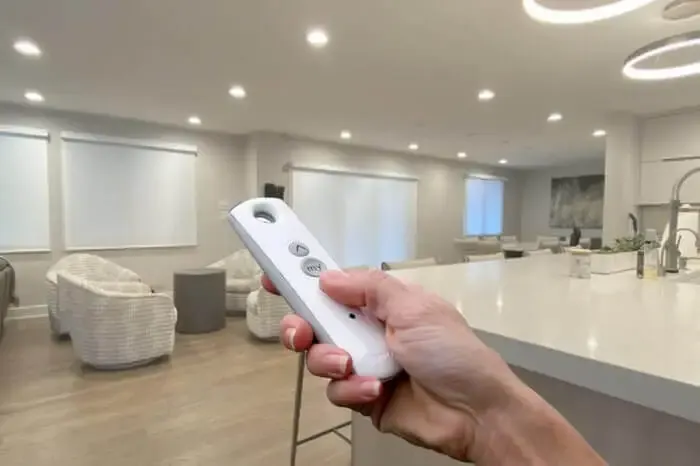
Motorization is the single biggest optional line on most window treatment quotes, and it's the one where the price spread makes the least sense from outside. Two shades that look identical can differ by hundreds of dollars because of how the motor gets power. Here's what actually drives the cost on a Zionsville job, what the first quote usually leaves out, and which openings return the money and which ones quietly don't.
The number, and what sits under it
Nationally, a motorized shade runs roughly $300 to $1,500 a window installed. That range covers everything from a small battery powered cellular shade to a wide hardwired blackout roller on a two story wall, which is why it's so wide. Size and fabric move you within that range, and so does the way the motor gets its power.
That last one is the lever most people don't know they have. Battery motors run roughly $100 to $300 a window less than hardwired ones. On six openings that's a meaningful difference, and on a whole floor it's the difference between doing the project now and putting it off. The catch is that you're trading a one time cost for an ongoing task, which is a fair trade in some houses and a bad one in others.
Warranty and who fixes it
Motorized shades have two warranties riding along, and they're rarely the same length. The fabric and mechanism warranty covers the shade. The motor and electronics warranty covers the moving part, and it usually runs shorter. Ask for both in writing, and ask a plainer question on top: who comes out when a motor fails in year three, and is the labor covered or only the part?
That's the real difference between buying a motorized shade from a company that measures and installs and buying one online. A motor is a mechanical thing that eventually stops. When the installer holds the account with the manufacturer, the claim goes through them and somebody shows up. When you bought it yourself, you own the phone call, the shipping and the reinstall.
Where motorization actually pays back
Think about it as buying behavior, not convenience. A shade you can move without getting up is a shade that gets used, and a shade that gets used does the job you bought it for. That's where the value hides.
High openings are the clearest case. Anything above eight feet, a stairwell, a transom over a door: hand operation there means a pole or a ladder, so those shades sit in one position for years. Motorize them and they start earning their keep against afternoon heat and glare. Two story great rooms are common in newer Zionsville construction, and those upper shades are exactly the ones that otherwise never get touched. The second clear case is a room with a wall of glass, where four or five shades should move as one. Nobody makes five trips. They make zero, and the shades stay wherever they were left.
The third is accessibility, and it's the one that justifies the cost fastest for anyone with limited reach or mobility. A wall switch or a phone beats a cord in a way that isn't about luxury at all.
The costs that don't appear on the first quote
- Batteries over time. Hunter Douglas publishes about a year of battery life for PowerView, and heavier shades on daily schedules run shorter. Rechargeable wands cost time rather than money. Alkaline packs cost money on a recurring basis.
- The hub. A direct remote costs nothing extra beyond the remote. Schedules, phone control and voice all require a hub or bridge, and that's a separate line.
- Repeaters. Big houses and masonry interiors eat radio range, and a far corner may need one.
- Electrical work. Hardwiring means low voltage runs and a power supply, which is a trade you're hiring on top of the shade order.
- Remote batteries and spare remotes. Small, but they're real, and a lost remote on a proprietary system isn't a drugstore purchase.
Getting it right the first time
Motorization is a decision that wants to be made before the order, not after. Retrofitting a motor into an existing shade is possible on some product lines and not on others, and even when it works you're often paying nearly what a new shade would cost. If motorized is a maybe, price it now while the fabric is being chosen.
The same is true for hardwiring. If any part of the house is going to be opened up, running low voltage wire while the wall is open costs a fraction of what fishing it later does. Custom lead times run two to five weeks either way, and Indiana requires a written contract with scope and total price for residential work over $150 under IC 24-5-11. Get the power method, the control type and the hub written into that scope for every opening in the Zionsville job rather than settling it verbally at the install.
National ranges put motorized shades around $300 to $1,500 a window installed, with battery motors $100 to $300 below hardwired. Spend it on high openings and rooms that should move together. Skip it on the bathroom window nobody touches. Get both warranties in writing along with who handles a failed motor in year three. Zionsville Window Treatments serves Zionsville and IN communities at (317) 863-9966.
Where the money is wasted
A small bathroom window you adjust twice a year does not need a motor. Neither does a closet, a laundry room, or a shade you keep down permanently for privacy. Motorizing a whole Zionsville house because it seems more consistent is the most common way people overspend on this. A mixed house, where the tall and awkward openings are motorized and the rest are cordless, is what most well planned jobs look like.
Skip the schedule if you're home all day and you'd rather press a button. That saves the hub and the setup. Direct remote systems also age better in one specific way: they don't depend on an app, a network or a company continuing to support a phone platform.
Frequently Asked Questions
How long do the batteries really last?
Hunter Douglas publishes about a year for PowerView, and that's a fair planning number across the category. Your mileage moves with use. A shade running twice daily on a schedule drains faster than one you touch on weekends, a wide blackout roller works harder than a small cellular shade, and cold rooms cut capacity. Rechargeable wands take hours to charge, not minutes. If you have a dozen battery shades, you're doing something about once a month.
Do I need a hub, or is a remote enough?
A remote is enough if you just want to press a button. It pairs directly to the shade over radio, needs no network, and keeps working during an outage. A hub adds schedules, phone control, voice and integration with other smart devices. It also adds a dependency on your network and on an app somebody else maintains. Start with the question of whether you want shades moving on a schedule. If not, skip the hub.
Can I add a motor to shades I already have?
Sometimes. Certain product lines are built so a motor can be retrofitted into the existing headrail or roller tube, and plenty of others aren't. Even when it's possible, the labor plus the motor often approaches the cost of a new motorized shade, so it's worth pricing both. If motorization is a maybe, price it at the time of the original order. That's much cheaper than deciding a year later.
What are travel limits and why do they matter?
They're the upper and lower stopping points programmed into each motor at install. They're what makes four shades on one wall stop at exactly the same height instead of a stair-step. Limits can shift after a battery change or if a shade hits an obstruction on the way down. Resetting them is usually a short procedure you can do yourself, so ask the installer to demonstrate it and to write down which channel runs which shade.
 Wood Blind Pricing in Zionsville: Stock Versus Custom Cost
 What Plantation Shutters Cost in Zionsville and Why They Last
 Designing Custom Drapery for Zionsville Rooms, One at a Time