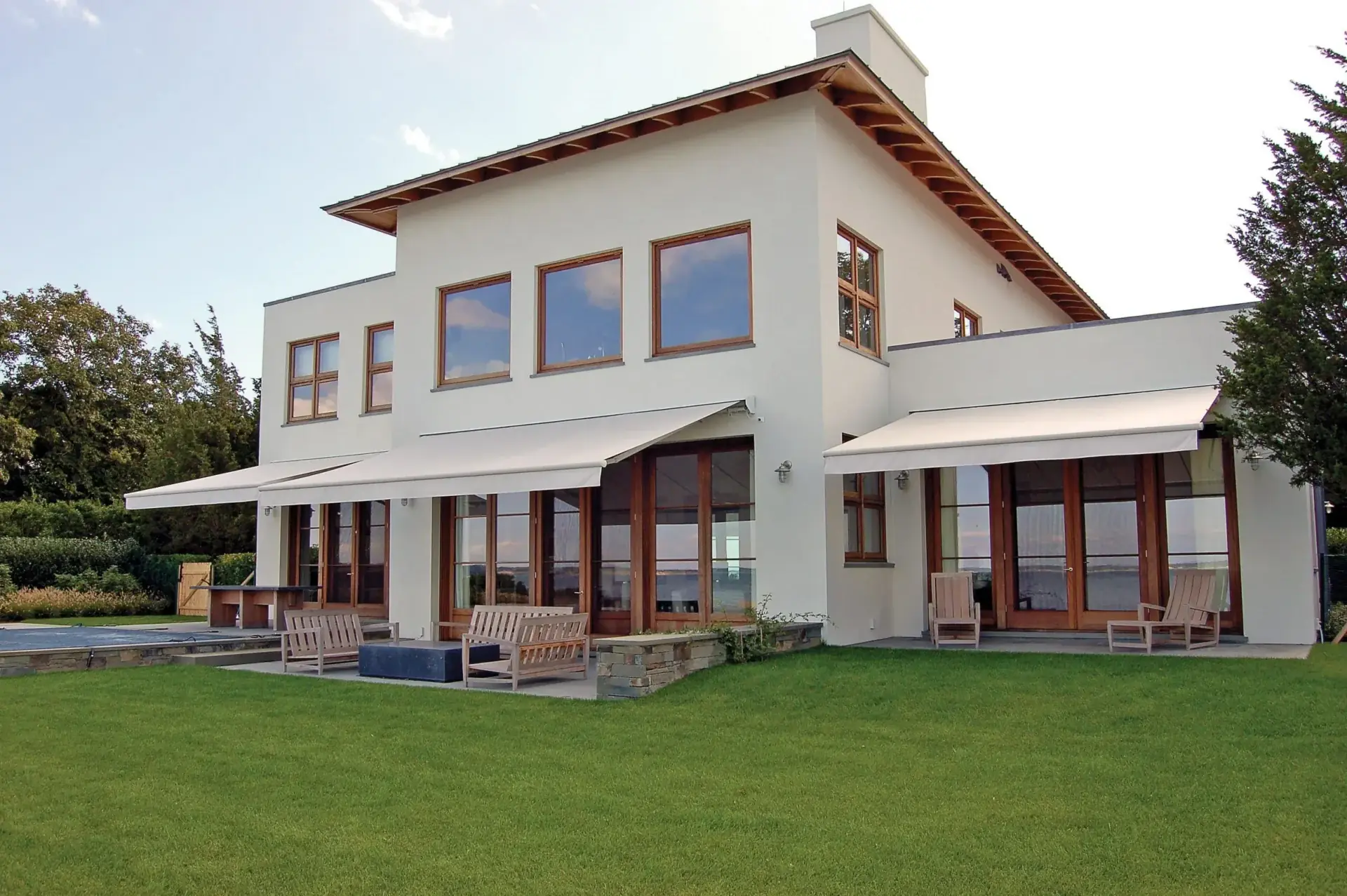
Roller Shades

Roller Shades in Zionsville by Zionsville Window Treatments

One fabric, one tube, roll direction settled early

Call (317) 863-9966Get Free Quote
Quick Answer

Answers here cover the whole lifecycle: measuring, ordering, fabrication, installation, care and service. A custom window covering is a long-term purchase and the later stages deserve as much attention as the first.

  • Service: Roller Shades for Zionsville homeowners
  • Service area: Zionsville, IN and surrounding areas
  • It depends what's broken. Hardware repairs on existing blinds and shades usually come together quickly. Replacing an entire custom product means starting the fabrication clock again, which is two to five weeks in most cases.
  • Insured and bonded
  • Serving Zionsville, IN since 2008
Roller Shades Services

Expert Roller Shades for Zionsville Homes

A roller shade is one fabric on one tube, and the simplicity is the point. It stacks to a small roll at the head, it needs less depth than most alternatives, and it puts nothing between you and the window except the fabric you chose. In Zionsville that suits two very different populations: the current custom construction at Holliday Farms and Promontory, where minimal frame detailing wants a treatment that disappears, and the Village houses where a heavy horizontal blind would fight the original casing.

Almost everything about the price and the look comes down to three decisions made before fabric. Tube diameter is set by width and drop, and it climbs faster than people expect on a tall opening. Whether the headrail runs exposed, behind a fascia or inside a cassette changes both the finished look and the mounting depth needed. And roll direction, regular or reverse, decides whether the fabric hangs close to the glass or clears a crank, a handle or a lock.

Roll direction is the one that gets people, so we settle it at the measure rather than at install. A reverse roll brings the fabric forward off the tube, which clears hardware and gives a cleaner face, but it's not compatible with a fascia on Lutron systems and it changes the light gap behavior at the sides. Getting it wrong isn't an adjustment. It's a remake, six weeks later.

When to Call

Signs You Need Roller Shades

If you notice any of these in your Zionsville home, it is worth booking a measure. None of it is urgent, and none of it fixes itself either.

You want the window covered without a visible mechanism

The reveal is too shallow for a blind headrail

Existing shades foul the crank or the lock

A modern room needs a treatment that reads as a plane

The shade creeps down and won't hold its position

Fabric has faded unevenly across a wide opening

You need a low stack that clears the view when raised

Two treatments are wanted on one bracket set

Our Process

How Zionsville Window Treatments Handles Roller Shades

Every job follows the same six-step process. Transparent, thorough, and done right the first time.

1

Look at the hardware

Before anything else we look at what's on the window: cranks, handles, locks, and how far each projects into the opening. That determines roll direction, and roll direction determines the bracket set, the fascia compatibility and how close the fabric hangs to the glass. On the 1970s stock out in the former township area, projecting hardware on a patio door is nearly always the deciding factor.

2

Measure and set the tube

Three widths, three heights and a diagonal, then we work out tube diameter from the finished width and drop. A tall opening needs a larger tube to carry the fabric without deflection, and a larger tube needs more depth at the head. That's why depth gets confirmed at the stop against the specific product line rather than against a general rule, since cassette and fascia depths differ line to line.

3

Choose the head treatment

An exposed roller is the cheapest and shows the tube. A fascia gives a flat front and hides the roll. A cassette encloses the tube on more sides and gives the cleanest finish, at the cost of more depth. On a Promontory or Holliday Farms opening with minimal frame detailing, the cassette usually reads correctly. In a Village house with heavy original casing, an exposed roller behind the trim often looks more honest.

4

State the light gap

Inside mount light gaps go on the quote in inches before you approve anything. Lutron publishes three quarters of an inch per side on Roller 20 and 64 and thirteen sixteenths on Roller 100, 150 and 300, with a standard factory deduction of one sixteenth per side. Shades 120 inches and taller, or with a height to width ratio of 4 to 1 or greater, get larger gaps than that, and we write it down.

5

Decide the operation

Within reach gets a cordless lift or a continuous cord loop with a chain tensioner fitted. Above reach gets motorized, with the battery arrangement quoted openly rather than mentioned afterward. Where several shades sit in one wall we group them so they move together, and where the room fails at the same hour every day a sun sensor or an astronomical timer is worth pricing.

6

Install and square the line

Brackets level and square to each other, fabric run to full drop and full lift several times, and the hem checked for tracking. A shade that walks on the tube shows up in the first ten cycles rather than in month six. Where a wall carries several shades, they get aligned to each other, because on a plain modern elevation the eye reads the shade line before it reads the trim.

Real Project Photos

Roller Shades in Zionsville

Photographs from real roller shades jobs completed by our crew in Zionsville and surrounding areas.
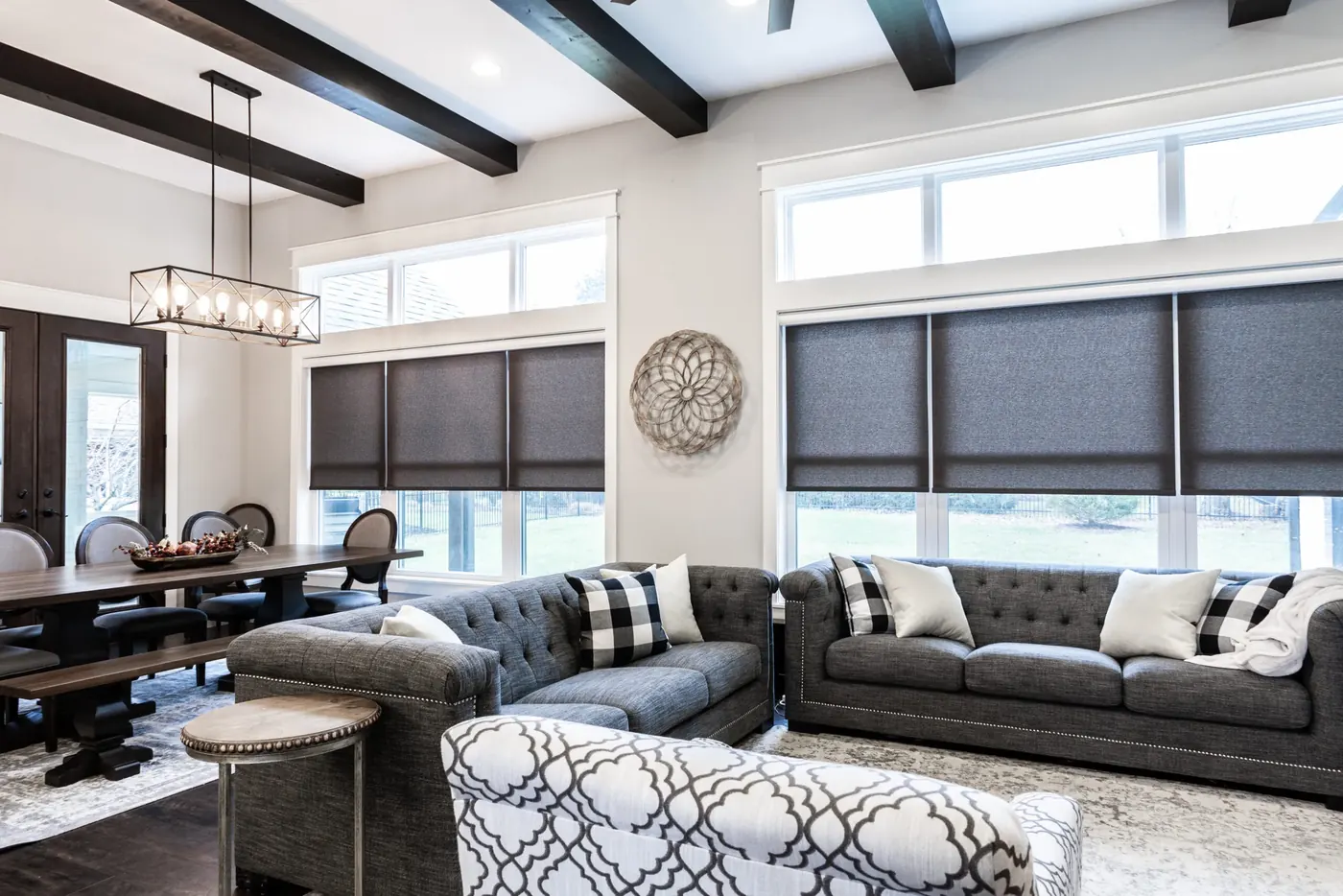
Custom shades measured and installed in Zionsville
Scope of Work

What Roller Shades Includes

Every Zionsville job is documented item by item. Here is what the crew covers.

Roll direction decided at the measure, regular or reverse, and written onto the order in plain words

Cranks, locks and handles inside the opening noted, because a regular roll drops the fabric straight onto them

Fascia and reverse roll checked against the manufacturer's own rules, since Lutron doesn't offer that pairing

Three widths and three heights taken per opening, plus a corner-to-corner square check

Mounting depth measured for the tube and bracket, then measured again if a cassette or fascia is wanted

Tube diameter sized to the finished width and the fabric weight so a long roll doesn't sag mid-span

Fabric opacity settled in writing before ordering, light filtering against room darkening against blackout

Side channels and a light-blocking bottom pocket specified where a room has to go dark rather than dim

Light gap per side disclosed at the measure and repeated on the paperwork before the order goes in

Shades over 120 inches tall, or past a 4:1 height-to-width ratio, flagged for larger gaps up front

Factory deduction left with the manufacturer, which is typically 1/16 inch per side

Chain side set window by window so the control lands on the hand you'd naturally reach with

Chain tensioner fastened per the product instructions on every continuous cord loop shade

Cordless and motorized lifts priced where a hanging chain doesn't belong in the room

Hembar chosen against the fabric weight, exposed aluminum or wrapped in the shade fabric

Coupled shades drawn across wide openings so two tubes turn together on a single line

Bracket substrate confirmed ahead of install day so the right anchor or trim screw goes in

Every shade run full travel twice on install day to prove the fabric tracks centered without telescoping

Pricing

What Roller Shades Cost in Zionsville

National category numbers put stock shades near $60 to $600 a window and custom-fabricated shades roughly $250 to $2,600. Those are national ranges for the category and they aren't a quote for anything in Zionsville. Rollers spread across most of that band, because a roller is really a fabric decision wearing some hardware. A basic light filtering fabric on an open roll with a chain sits low. A blackout fabric in a cassette with side channels and a wrapped hembar sits far higher, and it should, since you're buying a light seal rather than a shade. Motorization is its own line, nationally $300 to $1,500 per window installed. Zionsville Window Treatments prices from measured openings across Boone County.

By Product

How Roller Shades Differ by Product

Every product in this trade behaves differently in a room. Here is what that means for this work.

Open roll: The tube and brackets left exposed above the window. It's the least expensive hardware and the most honest looking on a modern opening, though you do see the roll of fabric and the bracket ends from below and from the side.

Fascia: A flat aluminum face that runs across the front of the tube and hides the roll. It gives you a clean horizontal line above the window and it's usually wrapped or powder-coated. Note that reverse roll and fascia don't pair on Lutron systems.

Cassette headbox: A closed box around the tube, open only at the bottom where the fabric comes out. It hides the roll from every angle, keeps dust off the top of the roll, and gives a blackout install somewhere to tuck the top light gap.

Regular roll: Fabric comes off the back of the tube, so it hangs close to the glass. It's the default, it looks tidiest, and it's the roll direction that will foul a crank, a lock or a handle sitting inside the opening if nobody checked.

Reverse roll: Fabric comes off the front of the tube, standing off the glass by an inch or so. Specify it when there's hardware in the opening the fabric has to clear, or when a deep sill would otherwise catch the bottom of the shade.

Light filtering fabric: A woven or vinyl face that passes diffused daylight without a view through it. Rooms stay bright and glare goes soft. It's the everyday specification for a kitchen, a family room or anywhere darkness isn't what you're buying.

Room darkening fabric: A denser fabric that cuts most of the light coming through the face. Bedrooms are the obvious use. Understand that the face is doing the work and the edges are not, so an inside mount still passes light down both sides.

Blackout fabric with side channels: An opaque fabric run inside aluminum channels at each side so the edge light has nowhere to go. Paired with a cassette above and a pocket at the bottom, this is what actually makes a room dark rather than merely dim.

Continuous cord loop with a clutch: A bead chain running over a clutch in the end of the tube, which is the standard manual control. It handles weight well on tall shades. The tensioner has to be fastened to the wall or frame, not left hanging.

Dual bracket: One bracket carrying two tubes at the same window, so a solar screen and a blackout can live together and be used at different hours. It needs mounting depth, which is why we measure for it rather than deciding later.

Light Control

See What Each Fabric Does To The Light

Pick a fabric below and the window updates. It's a drawing rather than a photograph, so read it as a rough guide to what each family does in a Zionsville room, and to what it doesn't do.

Fabric type

Sheer, 10 percent openness

Ten percent of the weave is open, so you keep the view and most of the daylight. Glare drops a little. After dark, once your lamps are on, someone outside can read shapes through it, which is why this belongs on a view window rather than a bedroom.

Openness factor is printed on the fabric card, so you can compare one line against another before you order anything.

Keeps the viewNot private after dark

Solar, 5 percent openness

The usual pick for a west window or a covered porch. You can still read the yard through it, glare comes down noticeably, and the fabric intercepts a good share of the sun before it reaches you at four in the afternoon.

It also cuts the UV landing on floors and furniture. NFRC puts UV at roughly 40 to 60 percent of fading damage, so this slows fading rather than stopping it.

View and glare controlSlows fading

Solar, 3 percent openness

A tighter weave. The room goes dimmer and the view drops back to an outline. Choose it where the sun is the problem and the view is second, which around here usually means a west wall in July. That's a common call on this side of Indianapolis.

Openness affects how much you see out, not how private you are. A 3 percent fabric still shows silhouettes at night.

View becomes an outlineStrong glare control

Solar, 1 percent openness

Close to a solid fabric with a little view left in it. This is the strongest glare control in the solar family.

The trade is that it darkens the room on a gray January day too. Indianapolis averages a January high near 36F and the light is flat, so think about how the room reads in both seasons before you commit.

Darkest solar optionDim on gray days

Light filtering

No view through it. Daylight comes through the face diffused, so the room stays bright without a hot spot across the television or the kitchen island. This is the default for living spaces.

It isn't private in reverse at night. With the lamps on and the sun down, silhouettes still show.

No view through itBright without the glare

Room darkening

A denser fabric, usually with a liner behind it. Most of the light coming through the face is gone.

Light still arrives around the edges on an inside mount, so a room darkening shade gives you a dim room rather than a dark one. If someone in the house sleeps during the day, say so at the measure and we'll scope it differently.

Dim, not darkEdges stay bright

Blackout

The fabric itself passes essentially no light. What you'll still see is the perimeter. Lutron publishes an inside-mount light gap of about 3/4 inch per side on its Roller 20 and 64 shades, along with a standard factory deduction of 1/16 inch per side, and shades over 120 inches tall or past a 4:1 height-to-width ratio get larger gaps than that.

So if you need a genuinely dark bedroom, that gap has to be dealt with on purpose, either with side channels or by going outside mount. We tell you which one your opening can carry while we're still standing in the room.

Dark facePerimeter needs a plan

Openness factor is a measured fabric spec, so you can compare it line to line. The category names are not measured. One maker's room darkening can behave like another maker's light filtering, which is why the sample books come to the measure and get opened in the room they're going in, at the hour that room has the problem.

Common Questions

Roller Shades FAQ

Questions we hear most often from Zionsville homeowners considering roller shades.

On a regular roll the fabric comes off the back of the tube and hangs close to the glass. On a reverse roll it comes off the front, so it hangs forward and clears anything projecting into the opening. Reverse roll gives a cleaner face because you don't see the tube behind the fabric, and it's the answer where a crank, a handle or a lock is in the way. The catch is that reverse roll isn't compatible with a fascia on Lutron systems, and it changes how light behaves at the sides. We decide it at the measure with the hardware in front of us.
On a Lutron Roller 20 or 64 it's three quarters of an inch per side, and thirteen sixteenths on Roller 100, 150 and 300, with a standard factory deduction of one sixteenth per side on top. Shades 120 inches and taller, or with a height to width ratio of 4 to 1 or greater, get larger gaps than that, which matters on the tall openings at Holliday Farms and Promontory. We put the number on the quote in inches. If a room needs true darkness, an inside mount is the wrong mount and the answer is an outside mount, side channels or a light blocking pocket.
That's cordless spring tension drifting, and it's the highest volume warranty item in this trade. A cordless roller uses a constant force spring sized to the weight of the fabric, and as the fabric relaxes over time the balance moves and the shade stops holding position. Sometimes it's adjustable, sometimes the spring assembly needs replacing, and either way it's a service call rather than a fabrication job so it doesn't wait weeks. What it usually isn't is the clutch, which tends to outlast the fabric on everything but the tallest drops.
Yes, and on a hard exposure it's often the right answer. A common arrangement is a solar fabric in front and a room darkening fabric behind, on a dual bracket set, so the room can hold its view during the day and go properly dark in the evening. It costs more than a single shade and it needs more depth at the head, so we confirm the reveal will take it before quoting. On a Stonegate or Austin Oaks great room where the same wall has to work at noon and at ten at night, it removes the compromise rather than splitting the difference.
Wider than most people think, and further than it should. Tube diameter carries the load, so a wider shade needs a fatter tube and more depth at the head, and past a certain point the fabric weight starts producing deflection and the hem stops hanging straight. Rather than run a single shade to its limit across a fairway facing wall at Holliday Farms, we usually split it into two on a shared bracket line, with the split placed on an existing mullion so it reads as part of the window rather than as a compromise.
Depends what the room is failing at. Light filtering fabric softens the light and keeps the room usable, and it gives daytime privacy without daytime darkness. A solar fabric with a stated openness factor holds the view and cuts glare, which is what a room with something worth looking at needs. Room darkening and blackout fabrics are for sleeping and screens. In practice we specify by wall rather than by room: the west wall of a Zionsville great room and the north wall of the same room rarely want the same fabric.
They do, and often better than a horizontal blind. The pre-1930 houses off Main Street have heavy applied casing that a roller can sit behind without competing with, and the roller needs less depth than a faux wood headrail, which matters where later storm panel and insert work has eaten one to two inches of the reveal. The complication is squareness. Nothing in that fabric measures square, so we three point measure, run the diagonal, and where the deviation is real we mount outside on the casing so the fabric hangs plumb against an opening that isn't.
Yes, and it does it unevenly, which is the part that catches people out. Ultraviolet accounts for roughly 40 to 60 percent of fading damage according to National Fenestration Rating Council guidance, and the room side face of a shade ages differently from the street side. Shades on a west or south wall will run ahead of shades on a north wall in the same room, so after several Zionsville summers, openings ordered together stop matching. Ordering a whole room from one dye lot at the outset is the best available protection, and we note the elevation of each opening so a later replacement starts from real information.
Roll direction is simply which side of the tube the fabric comes off. On a regular roll it comes off the back and hangs close to the glass, which looks tidiest. On a reverse roll it comes off the front and stands off the glass by an inch or so. It matters because anything living inside the opening, a crank, a lock, a stop or a deep sill, will catch a regular roll. That's a decision made standing at the window with a tape, not afterward from a photo.
On Lutron systems that combination isn't offered, so we design around it rather than pretending otherwise. The reason is geometry: a fascia sits in front of the tube, and a reverse roll brings the fabric down that same front face, so the two want the same space. Other manufacturers handle it differently, and we check the specific line we're quoting instead of stating a universal rule. If you want the fascia look and the fabric needs to clear hardware, a cassette usually solves both.
Open roll is the least expensive and it looks right on a modern opening where exposed hardware isn't a problem. A fascia gives you a flat clean line across the front and hides the roll from below. A cassette wraps the tube on all sides, which hides the roll from every angle and gives a blackout install somewhere to hide the top light gap. Depth is what decides it in practice, since a cassette needs more mounting room than a bare bracket does.
Enough that you should hear the number before you buy. The shade has to be narrower than the opening to travel, so the factory takes its deduction, typically 1/16 inch per side, and light comes down each side of the fabric. Lutron publishes 3/4 inch per side as a real inside-mount figure on Roller 20 and 64. Shades over 120 inches tall or past a 4:1 height-to-width ratio get larger gaps. If dark is the goal, an outside mount or side channels are the answer.
Room darkening describes the fabric. Blackout describes the whole install. A room darkening fabric blocks most of the light through its face and still passes light around every edge, which is why people call a bedroom dim and feel misled. A genuine blackout is an opaque fabric plus side channels, plus a cassette above and a pocket at the bottom, so the edges are closed too. We separate these in writing before ordering because the words get used loosely everywhere else.
Telescoping is fabric walking sideways on the tube as it rolls, so over a few cycles it creeps toward one end and starts rubbing a bracket. It usually comes from a tube that isn't level, a shade that was forced when it jammed, or fabric cut slightly off square. On a new install it's mostly prevented by mounting the brackets dead level and running the shade full travel twice before we leave. On an existing shade it can sometimes be corrected with shims at one bracket.
Wider than most people need, and the limit is deflection rather than fabric. As a shade gets wide, the tube has to carry its own weight plus the fabric across the span, and a tube that's too small for the width visibly dips in the middle. Manufacturers publish a tube diameter chart against width and fabric weight, and we work from that. Past the practical limit we couple two shades on one line so they turn together and read as a single treatment across the opening.
Chain is the standard and it handles weight best, which matters on a tall shade, but it means a loop hanging beside the window and a tensioner screwed to the wall. Cordless suits smaller shades and rooms where nothing should hang, though a very heavy shade fights a spring. Motors make sense on tall shades, on hard-to-reach windows and on a group you'd rather run together. Hunter Douglas states PowerView battery life is about a year, and batteries are the most under-disclosed cost on a motorized job.
Yes, and it's not a suggestion from us. The tensioner is the small device that anchors the bottom of a continuous cord loop so the chain stays taut against the wall or the frame instead of hanging as a free loop. It ships with the shade, the product instructions require it to be fastened, and a loose loop is exactly the hazard that the ANSI/WCMA A100.1-2022 work on cord access exists to address. We install it as part of the job rather than leaving it in the box.
Yes, on a dual bracket. One bracket carries two tubes at the same opening, so you can run a light filtering or solar fabric during the day and drop a room darkening or blackout shade at night. It's the honest answer when one fabric can't do both jobs, and it beats compromising on a single middle-of-the-road fabric that disappoints in both directions. It needs mounting depth, which is why we measure for the pair rather than adding one later.
Some fabrics curl slightly at the vertical edges over time, particularly lighter weight vinyls in a hot window, and it's a fabric property rather than a defect. Heavier woven fabrics and anything with a knit backing resist it. On the bottom, an exposed aluminum hembar hangs dead straight and is the practical choice on a wide shade, while a hembar wrapped in the fabric looks softer and is better on lighter fabrics. We match the hembar to the fabric weight rather than to a preference.
We can order the same fabric name if it's still in the line, and the color may not be identical. Fabrics run in dye lots, and a bolt woven this year can sit slightly off one woven two years ago, which nobody notices across a house and everybody notices on two windows in the same wall. The practical advice is the same as it is with paint: do a room at once. We write the fabric name and color onto your paperwork so a later order starts from the right reference.
Years, with honest caveats. Solar screen weaves and vinyl-faced fabrics hold up well against direct sun. Lighter decorative fabrics soften and lose color faster on a west or south window than the same fabric on a north one, and the exposed edge that sits outside the roll ages before the rest. Keeping the shade down through the worst afternoon hours actually protects the room behind it, which is the tradeoff. Fading in the room is reduced by the shade, not ended by it.
Two to five weeks is the normal custom fabrication window, with specialty fabrics and anything involving side channels or coupled tubes running toward the longer end. Motorized shades add a step because the tube gets built around the motor. None of that is a delay, it's a factory assembling to your measured sizes. You'll get the fabrication window in writing along with scope, dates and total price, which the Indiana Home Improvement Contract Act requires on residential work over $150.
Areas We Serve

Roller Shades Across Zionsville

We measure and install in every one of these Zionsville neighborhoods. Each has its own page with the build eras, window conditions and mounting notes for that section.

Free In-Home Measure

Schedule Your Free In-Home Measure in Zionsville

Contact Information

Reach Us Directly

Our team prioritizes scheduled measures and service calls, and books in-home measures during business hours.

Office
1417 Commerce Avenue, Indianapolis, IN 46201
Hours
Mon-Fri 8a-6p
Service Area
Zionsville, IN and Surrounding Areas

Ready to Book Your Measure?

Call us to set up an in-home measure, or to ask about a treatment that has stopped working. We will talk it through on the phone first.

Service area

Serving Zionsville and the surrounding area

Call NowGet Quote