Blackout Shades in Zionsville
Darkness is a mount decision before it is a fabric one
Read these before you choose a fabric. Material, mount and lift decisions constrain what fabrics make sense, and working in that order avoids falling for something that won't work in the room.
- Service: Blackout Shades for Zionsville homeowners
- Service area: Zionsville, IN and surrounding areas Honest structure: the measure happens on a normal appointment, the factory takes two to five weeks to build your order, and then we install. Service work on something already hanging moves much faster because nothing needs fabricating.
- Insured and bonded
- Serving Zionsville, IN since 2008
Expert Blackout Shades for Zionsville Homes
Blackout is the single most misunderstood word in this trade, and getting it right is mostly about the mount rather than the fabric. A blackout fabric blocks essentially all light through the material itself. What it can't do is block light that comes around it. On an inside mount there's a published gap at each side, so an inside mounted blackout shade produces a dim room rather than a dark one, every time, in every house.
The numbers are worth stating rather than gesturing at. Lutron publishes inside mount light gaps of three quarters of an inch per side on Roller 20 and 64 and thirteen sixteenths on Roller 100, 150 and 300, with a standard factory deduction of one sixteenth per side on top of that. Shades 120 inches and taller, or with a height to width ratio of 4 to 1 or greater, get larger gaps. Those are manufacturer figures, not our estimates, and they go on the quote.
So a genuinely dark room needs one of three things: an outside mount with generous overlap on all four sides, side channels that capture the fabric edges, or a light blocking pocket at the head that closes the gap above the roll. Each has a cost and each has a look. We price the one your opening can actually take, and in a Zionsville house with irregular reveals that decision changes room to room.
Signs You Need Blackout Shades
If you notice any of these in your Zionsville home, it is worth booking a measure. None of it is urgent, and none of it fixes itself either.
The bedroom never gets properly dark even with shades down
Light comes around the edges of an existing blackout shade
A lower level media room is unusable in daylight
Streetlights and headlights come into the room at night
Shift work or a young child needs daytime darkness
Summer daylight wakes the room hours too early
You've bought blackout once already and it disappointed
A projector wall needs the light controlled properly
How Zionsville Window Treatments Handles Blackout Shades
Every job follows the same six-step process. Transparent, thorough, and done right the first time.
Ask what dark means
There's a real difference between a room that reads dark to a sleeping adult and a room dark enough for daytime sleep or a projector. We ask which one you need, because the answer decides whether an outside mount alone is enough or whether side channels and a light blocking pocket belong in the quote. Buying the fabric and skipping the mount is how people end up disappointed twice.
Measure the whole wall
Blackout work gets measured differently. Three widths, three heights and a diagonal on the opening as usual, then the wall around it: how much overlap is available at each side, whether the casing will carry brackets, what's above the head, and whether a return wall or a corner limits the overlap on one side. That surrounding measurement is what decides how dark the room can get.
Choose the mount
An outside mount above the head with generous overlap is the simplest route and it costs the least. Side channels capture the fabric edges and get much closer to true darkness, at the cost of a visible channel each side. A light blocking pocket closes the gap above the roll where light leaks over the top. On a Village opening with irregular reveals, an outside mount is often the only honest option anyway.
Pick the fabric and the layer
Blackout roller fabric, blackout cellular and blackout lined Roman or drapery all get to the same place by different routes and they don't behave the same in winter. Blackout cellular holds an air layer against the glass, which helps in January and increases the condensation risk. A blackout roller with side channels does the light job most efficiently. In a bedroom we often specify two products rather than asking one to do everything.
Warn about condensation
A tight blackout arrangement against cold glass in a Zone 5A winter is where moisture collects, and side channels and light blocking pockets make it worse by design. The symptoms are dark spotting along the bottom rail, a musty smell, and staining that shows on the room side. We say this before the order, and we talk about running the shade partly up on the coldest nights.
Install and hunt the leaks
Brackets level, shade hung, then the lights go off and we look at the opening from inside in the dark. Leaks at the head, at the channel returns and at the hem are all fixable at install with adjustment or additional trim, and they're much harder to fix once the household has moved back into the room. You should see the room dark before we leave.
Blackout Shades in Zionsville
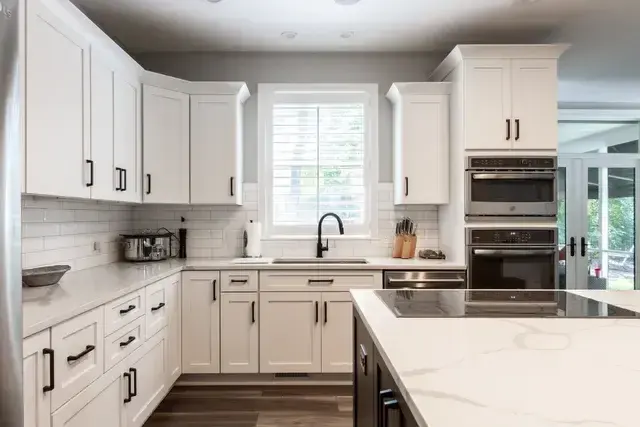
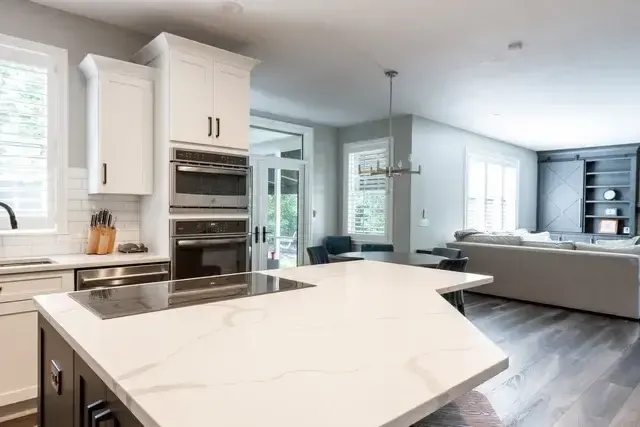
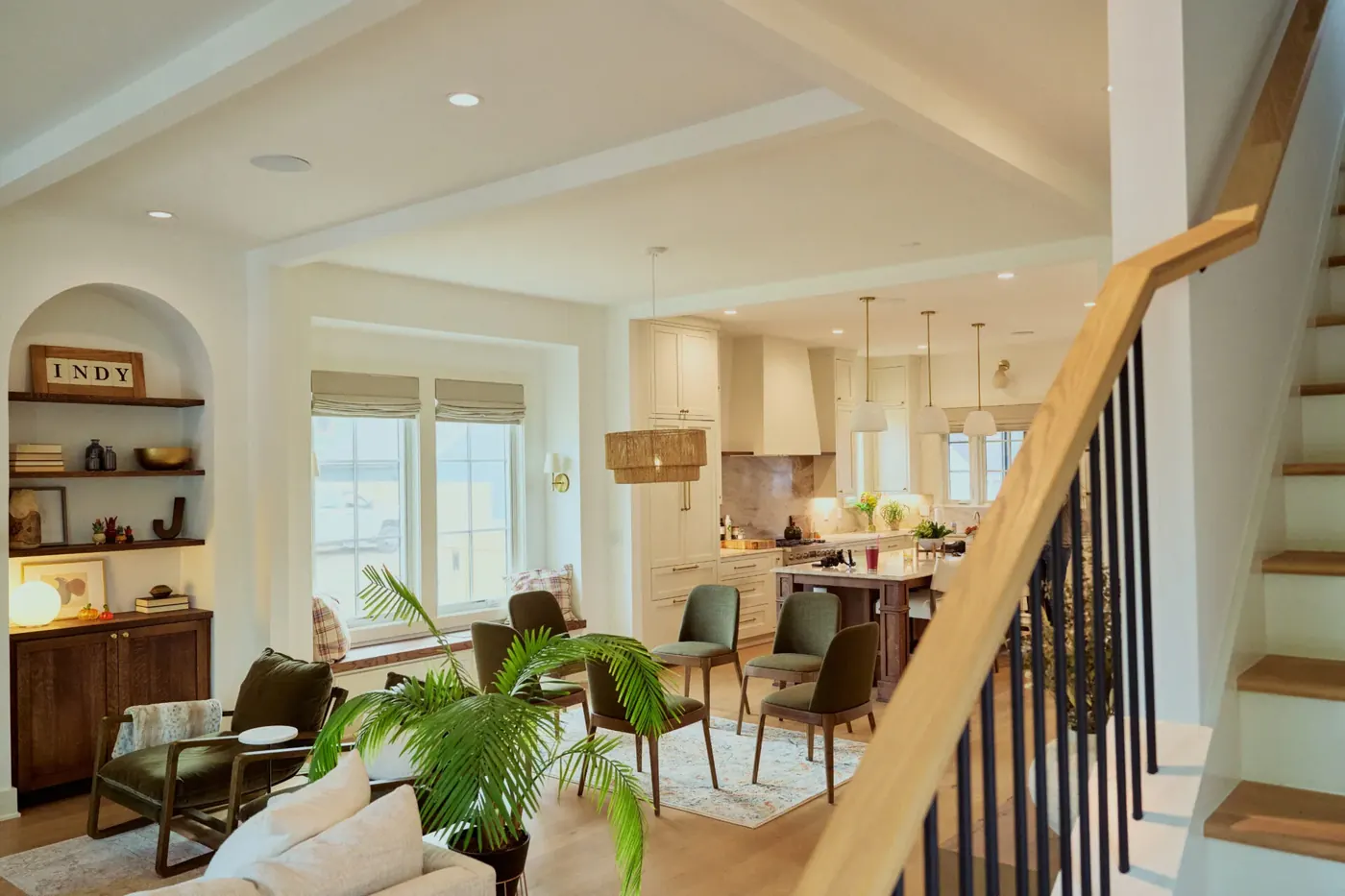
Photographs from real blackout shades jobs completed by our crew in Zionsville and surrounding areas.
What Blackout Shades Includes
Every Zionsville job is documented item by item. Here is what the crew covers.
The actual goal settled first, since a room dark enough to sleep in and a genuinely dark room need different products
Every opening measured and checked on the diagonal, because a shade hanging out of level leaks down one side
Outside light sources logged at the measure: a street lamp, a security light, headlights sweeping a bend
Wall surface above and beside the opening checked for somewhere flat and solid to land channels
Outside mount specified wherever real darkness is the goal, with overlap written in inches on every side
Side channels specified where the room has to be dark and the wall around the opening will take them
A light-blocking pocket or a closed cassette specified at the top so daylight can't come over the roller
Factory deduction disclosed up front, since Lutron publishes 1/16 inch per side and that width has to go somewhere
Inside-mount light gap stated in writing, using Lutron's published 3/4 inch per side on Roller 20/64
Tall or narrow units flagged, because shades past 120 inches or a 4:1 height-to-width ratio get larger gaps
The bottom of the shade addressed on its own: hembar position, sill depth and light bouncing off the sill
Fabric named honestly as room darkening or blackout on the order, because the two aren't the same thing
Seam construction checked on any fabric going into a room that has to be dark, so needle holes don't become pinholes of light
Wall and ceiling color discussed, since a bright white room bounces whatever daylight does get past the shade
Cordless or motorized lift specified in nurseries and kids' rooms, to ANSI/WCMA A100.1-2022
Layering planned where one product can't finish the job, such as a blackout roller under lined panels
Channels fastened plumb down both sides, since a bowed track opens a gap of its own
The finished shade run through full travel and looked at with the room lights off, in daylight, before we leave
What Blackout Shades Cost in Zionsville
National figures put stock shades at roughly $60 to $600 per window and custom-fabricated shades at roughly $250 to $2,600 per window. Those are national ranges for a category and not a quote for a bedroom in Zionsville. Blackout has a wrinkle the other categories don't: the fabric is rarely the expensive part. Getting a room actually dark means an outside mount with real overlap, side channels down both sides and a pocket or closed cassette at the top, and that hardware can cost as much as the shade it surrounds. A bare blackout roller is cheap and it will disappoint you. Zionsville Window Treatments prices the whole assembly for Boone County rooms, because pricing the fabric alone is how customers end up unhappy.
How Blackout Shades Differ by Product
Every product in this trade behaves differently in a room. Here is what that means for this work.
Blackout roller shade: A dense coated fabric on a tube, the workhorse of this category. The cloth itself passes essentially no light. Everything about whether the room goes dark comes down to what you put around the edges of it, not the fabric you picked.
Blackout cellular shade: A honeycomb with a blackout layer inside the cells, which adds an insulating air pocket the roller doesn't have. It's the better choice on a cold bedroom window in January, and it pairs with side tracks the same way a roller does.
Side channels: Aluminum or vinyl tracks running down both sides that capture the fabric edge. This is the single component that turns a dark shade into a dark room. They're visible, they add width to the outside of the opening, and they need a flat mounting surface.
Light-blocking pocket: A three-sided box mounted above the shade that closes off the top and the upper corners. Light comes over a roller as easily as around it, and a pocket is what shuts that path without relying on the fabric wrapping the tube.
Closed cassette: A headrail enclosing the roller on all sides with a fabric slot at the bottom. It handles the top gap the way a pocket does while looking like finished hardware rather than a built element, and it suits a wall with no depth above.
Outside mount with overlap: Mounting past the trim on all four sides, so the fabric covers more than the opening. The cheapest real improvement in this category. Two or three inches of overlap per side does more for darkness than upgrading the fabric ever will.
Room darkening fabric: A fabric that cuts most light without being opaque, usually with a soft glow through the cloth. It's enough for a guest room or a den, it costs less, and calling it blackout is the most common mislabeling in this trade.
Dual shade on one bracket: A solar screen and a blackout shade on a single bracket set, operated separately. You keep the view and glare control during the day and drop the blackout at night, which is how a bedroom that's also a sitting room gets solved.
Motorized blackout: A motor lets a channeled shade run its full travel without anyone fighting a track, and it puts a dark room on a schedule. On battery, expect to change or recharge roughly once a year, which is the cost nobody mentions at the sale.
Blackout lined drapery over a shade: Panels handle the softness and the sides while the shade handles the glass. The combination reaches a level of darkness neither one gets to alone, and it's often the better-looking answer in a primary bedroom.
See What Each Fabric Does To The Light
Pick a fabric below and the window updates. It's a drawing rather than a photograph, so read it as a rough guide to what each family does in a Zionsville room, and to what it doesn't do.
Openness factor is a measured fabric spec, so you can compare it line to line. The category names are not measured. One maker's room darkening can behave like another maker's light filtering, which is why the sample books come to the measure and get opened in the room they're going in, at the hour that room has the problem.
Blackout Shades FAQ
Questions we hear most often from Zionsville homeowners considering blackout shades.
Blackout Shades Across Zionsville
We measure and install in every one of these Zionsville neighborhoods. Each has its own page with the build eras, window conditions and mounting notes for that section.
Other Window Treatment Services in Zionsville
Zionsville Window Treatments handles the full scope of window treatment work. Explore our other services below.
Schedule Your Free In-Home Measure in Zionsville
Reach Us Directly
Our team prioritizes scheduled measures and service calls, and books in-home measures during business hours.
Ready to Book Your Measure?
Call us to set up an in-home measure, or to ask about a treatment that has stopped working. We will talk it through on the phone first.