What It Costs to Address Drafty Windows in Zionsville
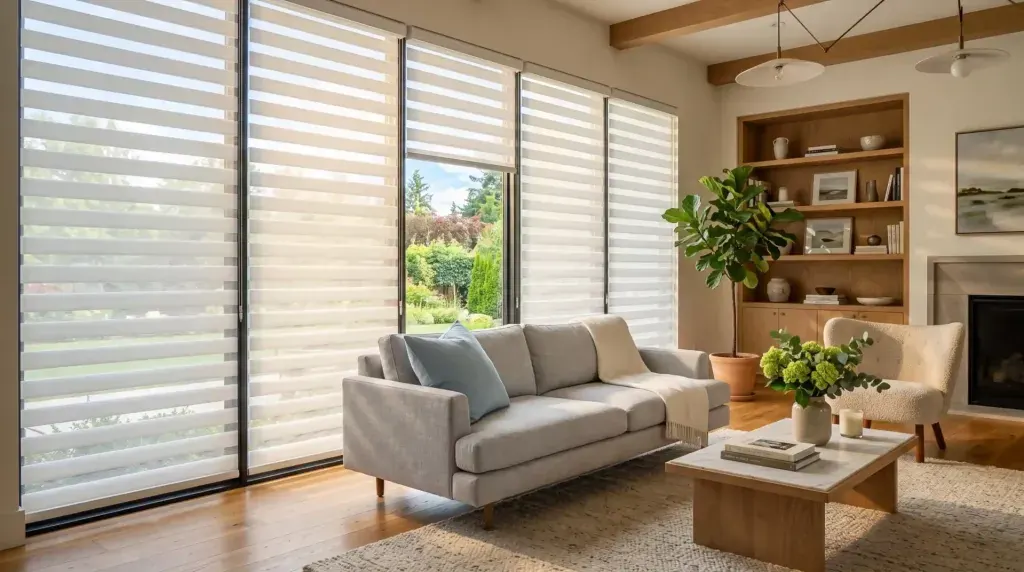
Budgeting for window treatments in an older Zionsville home means figuring out where the coldest rooms actually are before deciding what to spend where.
Why Older Windows Feel Colder Than the Thermostat Says
Here's the thing people get wrong most often: they assume a cold room means a leaky window, order weatherstripping, seal every gap they can find, and the room's still cold. That's because a big part of what you're feeling isn't moving air at all. It's radiant heat loss, your body cooling toward a cold surface, plus a convective loop where air against that cold glass sinks and rolls across the floor. Both happen on a window with a perfectly good seal.
Older glass in a lot of Zionsville homes makes this more obvious, since the surface temperature of single-pane or early double-pane glass runs colder than current glass on a cold night. The thermostat has no way to measure any of this. It just reads air temperature at one spot in the room, which is why two people standing in the same room can disagree about whether it's actually cold.
How Cellular Shades Trap Air Instead of Just Blocking Light
Cellular shades cost more than a basic roller or a set of aluminum blinds, and the honeycomb construction is why. Rows of small air-filled cells sit between the fabric layers, and that trapped air gives the shade an actual insulating value on top of blocking light, something a flat roller shade fabric doesn't provide regardless of how heavy the material is.
Single-cell fabric is the more affordable option and still adds a real air buffer, generally in the R-1.5 to R-2 range per manufacturer specs. Double-cell steps up in price, often meaningfully, in exchange for a second row of pockets and a published R-value more like R-3 to R-3.5. For a budget covering several windows, it's reasonable to put double-cell where a room is genuinely cold, sunrooms and north-facing bedrooms among them, and stick with single-cell everywhere else in the house.
Mount Style and Fit Change How Much Draft Gets Through
Picture a bay window or a sliding glass door, common trouble spots for cold rooms, and it's easy to see why fit matters so much. An inside-mounted shade on a bay window leaves small gaps at each angle where the panes meet, and that's exactly where the cold air rolling off the glass finds its way past the shade and into the room.
Mounting the shade outside the frame instead, so it overlaps the wall or trim on all sides, closes off more of that path. It's a better fit for a drafty corner window or an old sliding door track that was never great at sealing to begin with. Side channels are worth asking about on these problem spots too. They run down the edges and close the last bit of gap a plain outside mount leaves open.
What Window Treatments Can and Can't Fix
Here's the honest version. Cellular shades and layered drapery reduce the radiant chill and the convective draft coming off cold glass, and people notice the difference sitting near a window in the evening. What they don't do is seal an actual air leak where a frame has failed, weatherstripping has worn out, or a window doesn't close tight anymore. That's a separate project, and no fabric treatment substitutes for it.
The two problems usually show up together in an older Zionsville house, which is why the combination works: address the worst of the actual leaks where it makes sense to, and let the shade or drapery handle the radiant and convective chill that would still be there even on a perfectly sealed window. Treating it as an either/or question usually leads to disappointment either way.
If a room in your house never quite feels as warm as the thermostat claims, a free in-home measure is a straightforward way to find out whether the fix is a shade, a layered setup, or something with the window itself.
Layering Shades and Drapery for the Coldest Rooms
Think of the cellular shade as doing the primary work and drapery as a finishing layer on top of it, not a replacement for it. A lined drapery panel hung over a properly fitted cellular shade adds a second buffer of still air, and it's the layer people actually feel when they walk past a window at night, since it's the surface closest to the room.
For a genuinely cold room, room-darkening or blackout cell fabric under a lined panel stacks light control with the insulating benefit, useful in a Zionsville bedroom that faces a cold exposure. The combination costs more than either treatment alone, but it's the setup that shows up most often in the rooms homeowners describe as the worst in the house before treatment and the most improved after.
Frequently Asked Questions
Will cellular shades stop a window from feeling drafty?
They'll reduce the radiant chill and the convective draft that come off cold glass, which is most of what people notice sitting near a window in winter. They won't stop an actual air leak from a failed seal or worn weatherstripping. That's a separate repair, worth checking for before assuming shades alone will solve a cold room.
What's the difference between single-cell and double-cell shades?
Single-cell fabric has one row of air pockets and double-cell has two, stacked front to back. Double-cell insulates somewhat better, generally in the R-3 to R-3.5 range compared to R-1.5 to R-2 for single-cell, but costs more and stacks a little thicker at the top when raised. For a genuinely cold room it's usually worth the difference.
Does mount style really make that much difference?
It can. Inside-mounted shades leave a small gap between the fabric and the frame on both sides, right where cold air rolling off the glass gets past the shade. Outside mount overlaps the frame instead, which usually closes off more of that path, especially on an older or slightly out-of-square window.
 Motorized or Manual: Choosing Shades for a Bay or Bow Window
 The Best Window Coverings for a Zionsville Kitchen Sink Window
 Should You Measure Your Own Windows in Zionsville, or Book the Free Measure?